
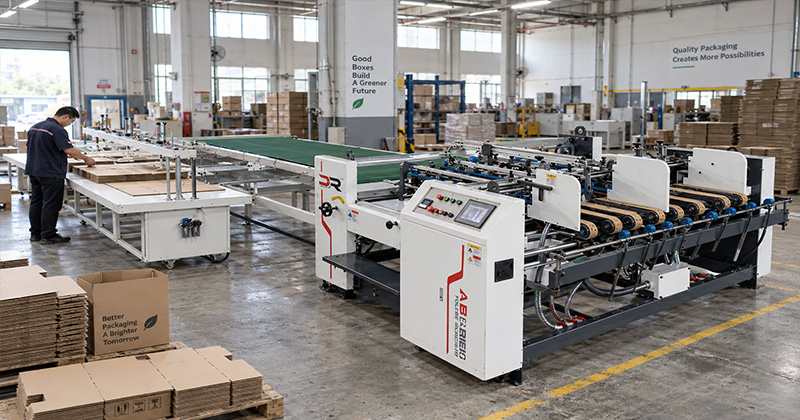
A two-piece folder gluer is not a machine that should be selected from speed alone.
The first thing we normally ask a buyer for is a carton drawing.
That one drawing often tells us more than a long list of questions, because it shows the open size, joint position, folding structure and whether the carton is really suitable for a two-piece process.
Two-piece carton production is common when one sheet is not practical because of carton size, board layout or production method. It is often seen in large corrugated boxes for appliances, furniture, industrial products and transport packaging.
The machine has to control two sheets before it can make one good box
The main challenge is alignment.
Two sheets enter the machine separately, but after positioning and gluing they must behave like one piece.
If the alignment is unstable, problems appear later:
the joint is uneven
folding lines do not match
the carton becomes twisted
the finished box does not close correctly
That is why buyers should pay attention to the feeding and positioning system, not just the gluing section.
Servo-controlled feeding and correction can help improve consistency, particularly when carton sizes change frequently.
Board type matters
Corrugated board is not one material.
E flute, B flute, C flute and double-wall board behave differently during feeding and folding.
A thick or slightly warped board is much harder to control than a flat, thin board.
Before asking for a quotation, buyers should provide:
flute type
board thickness
maximum open size
minimum open size
whether the board is laminated
whether the printed surface has any special coating
This helps determine whether the standard feeding and folding configuration is suitable.
Be careful with speed figures
A large carton and a small carton will not run at the same practical speed.
The same is true for a flat E-flute sheet compared with a heavier double-wall board.
For some two-piece machines, the quoted maximum output may be several thousand sheets per hour, but the real production speed depends heavily on the carton.
A better question is:
Can you test my carton structure and tell me the recommended running speed?
For overseas machinery purchases, a video of the machine running a similar product can also be very useful.
Glue choice depends on the carton
Different jobs may use cold glue, hot melt glue or a combination.
Hot melt is useful where fast bonding is needed. Cold glue is widely used in many conventional carton applications.
The right solution depends on:
board surface
production speed
joint area
bonding requirement
customer production practice
Some high-speed lines use separate glue systems at different stages. This is worth confirming during technical discussions rather than assuming every two-piece folder gluer uses the same gluing method.
Why A-Type, B-Type and C-Type names can be confusing
Manufacturers often use their own series names.
An A-type machine from one supplier does not necessarily mean the same thing as an A-type machine from another supplier.
The actual differences may involve:
number of working stations
feeding structure
carton size range
folding method
positioning method
correction system
collection method
So when comparing machines, compare the process and functions instead of only comparing series names.
What should you send the supplier?
For a two-piece folder gluer, we suggest sending:
carton drawing
open dimensions
finished dimensions
flute type
board thickness
product photos
required output
glue preference if known
current production method
a short video if the carton has an unusual structure
For many projects, this information is enough to rule out unsuitable models quickly.