
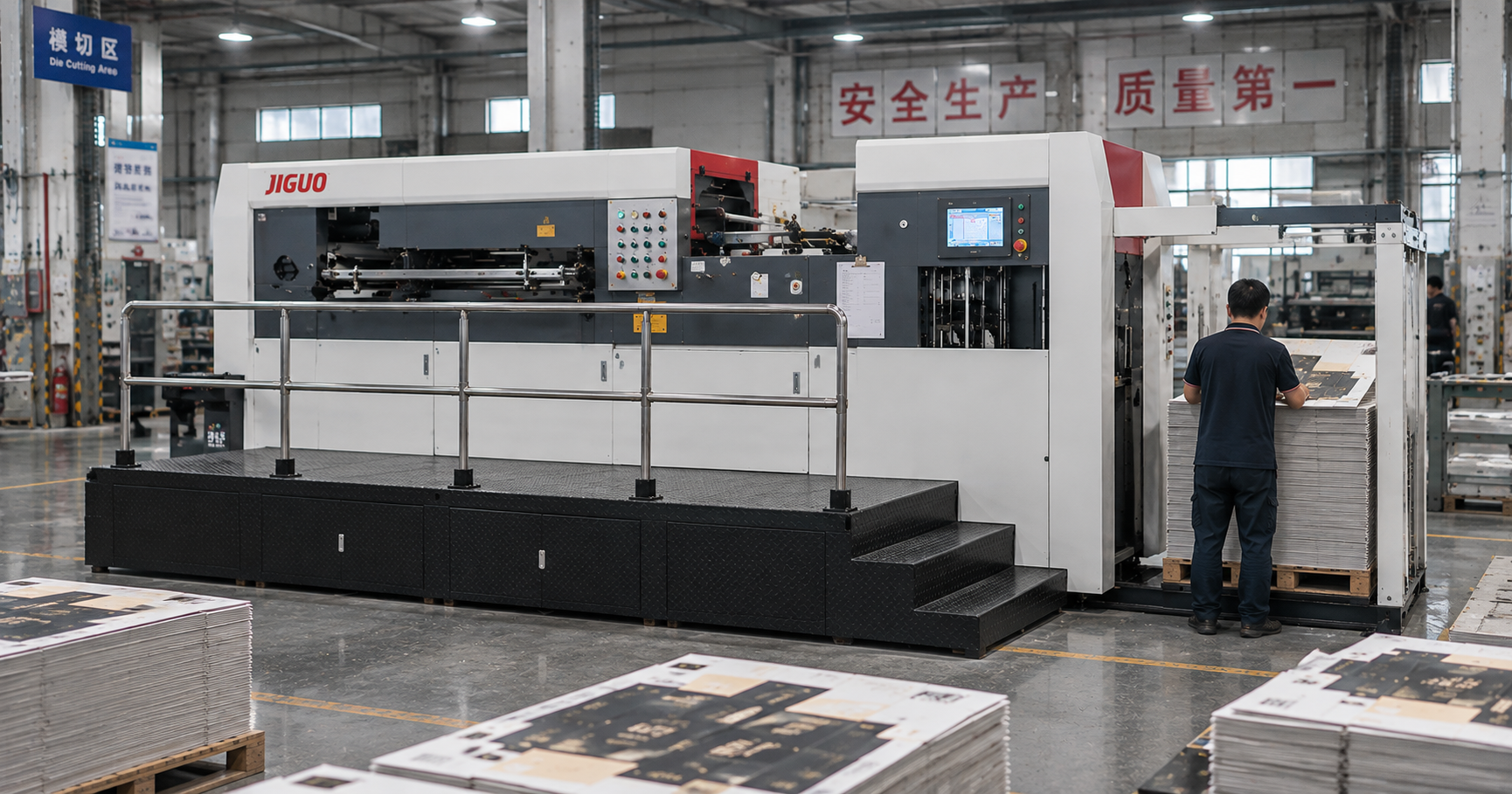
When buyers ask us which automatic die cutting machine they should choose, machine speed is rarely the first thing we look at.
We normally start with four questions: What material are you running? What is the largest sheet? What kind of finished product are you making? Do you need only die cutting, or die cutting together with stripping, blanking, foil stamping or embossing?
Two machines may look very similar in a brochure, but they can behave very differently once real production starts.
Start with the material, not the machine model
A folding carton plant processing 300–400 gsm paperboard has different requirements from a printer running thin coated paper.
Thin paper, for example, places more demand on feeding stability and sheet control. If the sheet is light or slightly curled, high nominal speed means very little if the feeder cannot keep the paper stable.
Heavy board and corrugated material bring another set of concerns. In those jobs, buyers normally pay more attention to feeding strength, pressure, stripping stability and the ability of the machine to handle large sheets without constant adjustment.
This is why we usually ask buyers to provide the actual material specification instead of simply saying “paper” or “carton board.”
Information such as:
120 gsm paper
157 gsm coated paper
350 gsm paperboard
E-flute or B-flute corrugated board
is far more useful when selecting a machine.
Sheet size determines more than the machine width
A common mistake is to choose the next larger machine “just to be safe.”
That can work, but it may also mean a larger footprint, higher power consumption and unnecessary investment.
The better approach is to provide the maximum and minimum sheet size you actually run. If possible, send the imposition or dieline as well.
For carton production, the open sheet size matters more than the finished box dimensions.
A buyer may tell us the box is only 300 × 200 mm, but after layout and imposition the sheet requirement can be very different.
Maximum speed and stable speed are not the same thing
This is one of the most important points when comparing die cutters.
A brochure may show 7,500 or 8,000 sheets per hour. That is useful as a reference, but it does not mean every material and every job will run continuously at that speed.
Actual stable speed depends on:
paper thickness
sheet flatness
sheet size
cutting layout
stripping complexity
operator setup
upstream printing quality
When comparing machines, we suggest asking:
What stable speed can this machine achieve with my material and my sheet size?
That question usually tells you more than the maximum-speed figure alone.
Do you really need stripping or blanking?
For some factories, a standard automatic die cutter is enough.
For others, labor after die cutting becomes the real bottleneck.
If waste still has to be removed manually after every sheet, adding an automatic stripping section can reduce a significant amount of manual work.
Blanking goes one step further by separating finished blanks automatically. It is useful for high-volume carton production, but it also adds cost and setup requirements.
The correct choice depends on your order structure.
If most jobs are short runs with frequent changeovers, flexibility may matter more than full automation. If you are producing large quantities of similar cartons every day, automatic stripping and blanking may make much more sense.
Die-cutting pressure should match the job
Pressure is another specification that is often used as a headline number.
Higher pressure is useful, but more is not automatically better.
For normal folding cartons, the key question is whether the machine can maintain stable and even pressure across the working area.
For deep embossing, heavy board or certain large-format jobs, higher pressure becomes more important.
In some applications, buyers may compare machines in the 700-ton or 900-ton class. The decision should still come back to the product being made rather than the number itself.
What information should you send before asking for a quotation?
For a more accurate machine recommendation, prepare:
product type
paper or board specification
maximum and minimum sheet size
required production speed
whether stripping is required
whether blanking is required
whether embossing or foil stamping is involved
current production method
destination country and voltage
Photos, videos and actual samples are even better.